Best Mid-Size Pickup Trucks in 2026: What Independent Reviewers Actually Say
Six trucks compete for the mid-size crown in 2026, and the gaps between them have grown. Towing capacity spans nearly 2,700 lbs across the segment. One runs a unibody chassis; the rest are body-on-frame. The spec-sheet differences are real, and so are the tradeoffs independent reviewers keep flagging.
The short version
The Toyota Tacoma holds the widest consensus as the segment’s top recommendation — Kelley Blue Book named it its Best Mid-size Truck for 2026 — but Consumer Reports reliability data throws cold water on the redesigned platform. The Ford Ranger is the smoothest driver and a serious tower. The Chevrolet Colorado, particularly the ZR2, is the enthusiast pick for combined on/off-road capability at a lower price than comparable Tacoma trims. The Honda Ridgeline wins for daily-driver comfort, with caveats. The Nissan Frontier is the budget anchor at $32,150. The Jeep Gladiator finishes last in The Car Guide’s head-to-head but remains the only mid-sizer you can drive with the windshield folded flat and the doors pulled off.
What the reviews agree on
The Tacoma covers the most ground
The Car Guide’s 2026 mid-size comparison highlights the Tacoma’s 14 available configurations — a breadth no rival matches, from a base SR to the factory-lifted TRD Pro. The TRD Pro includes Crawl Control (a low-speed off-road cruise system), a rear electronic locker, and a front sway-bar disconnect. The i-FORCE MAX hybrid powertrain pairs a 2.4-liter turbo-four with an electric motor for 326 hp and 465 lb-ft of torque — the highest torque output of any standard mid-sizer in the segment. Edmunds recorded 22.6 mpg on their evaluation route with the hybrid, against an EPA estimate of 22–23 mpg combined for 4WD trims.
The Colorado tows hardest and handles best on-road
The Car Guide handed their comparison-test win to the Chevrolet Colorado and its twin the GMC Canyon, citing “handling, refinement, space and technology.” The 2.7-liter TurboMax produces 430 lb-ft of torque and hauls up to 7,700 lbs — segment-best on both counts. MotorTrend specifically named the Colorado ZR2 the class benchmark for off-road value; its Multimatic DSSV spool-valve shocks are borrowed from performance car applications. The ZR2 Bison undercuts a comparably equipped Tacoma TRD Pro by roughly $11,000–$12,000, a figure that appears consistently across reviewer pricing breakdowns.
The Ranger rides best on pavement
Edmunds’ long-term simultaneous comparison of the Ranger, Tacoma, and Colorado found the Ranger the smoothest over broken road. Car and Driver scored it 9/10; Kelley Blue Book gave it 4.7 out of 5. A tested Ranger Lariat reached 60 mph in 6.7 seconds — a full second quicker than a comparable Tacoma in independent testing. Max tow is 7,500 lbs with the trailer package, and payload tops out at 1,767 lbs. The optional 2.7-liter V6 (315 hp, 400 lb-ft) gives the Lariat a power profile that overlaps with the Colorado’s top tune without forcing a step to an off-road-focused variant.
The Ridgeline is the easiest to live with daily
Edmunds rates the 2026 Ridgeline at 9.1/10, the segment’s top score. The Drive’s Joel Feder drove the TrailSport and came away at 7/10, calling it “the truck I need, but not the truck I want” — which captures the trade-off honestly. AWD is standard on every trim. The dual-action tailgate and 7.3 cubic feet of underfloor bed storage are practical differentiators that appear in nearly every review. The naturally aspirated 3.5-liter V6 feels deliberate by turbo-truck standards, but it also avoids the forced-induction complexity that’s dragging the redesigned Tacoma in Consumer Reports surveys.
The Frontier is the honest budget option
At $32,150, the Frontier undercuts every rival. US News and The Car Guide both credit its core competence: a proven V6, a 9-speed automatic, and controls that don’t demand a tutorial. No reviewer calls it exciting. Several note that its low-drama ownership record is the whole pitch.
Where they disagree
The Tacoma’s reliability reputation vs. its 2026 score
This is the segment’s sharpest fault line. Consumer Reports’ 2026 data — drawn from owner surveys of over 300,000 vehicles — puts the redesigned Tacoma (new platform, turbocharged engine, updated electronics from 2024) at just 29 out of 100 for predicted reliability, near the bottom of all rated vehicles. Pickup Truck Talk’s analysis of the Consumer Reports findings notes this pattern is typical of freshly redesigned trucks in early production years. KBB still named it its best-in-class pick for 2026. Those two conclusions are genuinely at odds, and buyers relying on the Tacoma’s decade-old reliability halo are working from data that may no longer apply to the current truck.
The Ridgeline: segment leader or expensive crossover?
Edmunds puts it at the top of the ranking. The Drive doesn’t. The Drive’s TrailSport test produced specific, measurable complaints: infotainment described as having “slow response time,” real-world fuel economy of 16.7 mpg (worse than body-on-frame V6 rivals), and a 5,000-lb tow limit — 2,500 lbs behind the Ranger. Consumer Reports also flagged below-average build quality despite otherwise strong reliability scores. The base price of $42,490 sits roughly $8,000–$10,000 above segment entry points. For buyers who prioritize daily-driver comfort over capability metrics, the Edmunds score makes sense. For buyers planning to tow regularly or who balked at the price, the trade-off math flips.
Off-road bragging rights: ZR2 vs. TRD Pro vs. Gladiator Rubicon
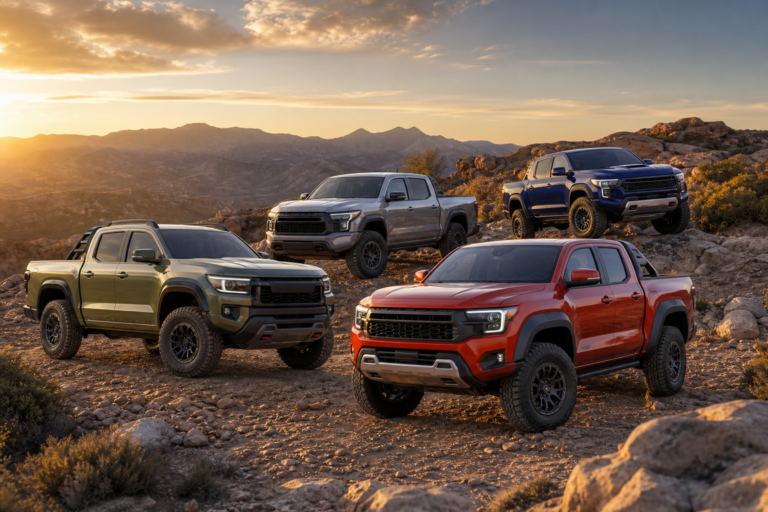
Edmunds tested the Colorado ZR2 Bison, Ranger Raptor, and Tacoma TRD Pro together and found each tuned for a different terrain. The ZR2’s Multimatic shocks favor high-speed desert work; the TRD Pro’s crawling hardware suits technical rocks. The Jeep Gladiator Rubicon brings the most sheer trail hardware — Dana front and rear axles, disconnecting sway bar, dual electronic lockers, and an available factory winch on the Shadow Ops edition. The Mojave X trim posts a 44.7-degree approach angle and 11.6 inches of ground clearance. But The Car Guide’s 2026 Gladiator review is direct: it “came in dead last” in their mid-size segment comparison overall, recording 13.4 L/100km in observed fuel consumption. No single outlet crowned one winner across all three off-road variants.
The Frontier’s 2026 value question
The Car Guide flags that Nissan trimmed the Frontier’s lineup while raising prices by roughly $3,000 for 2026 — narrowing the gap between the Frontier and the Ford Ranger in some configurations. The Ranger offers a more refined package at overlapping prices. US News still ranks the Frontier well for value. Whether it remains the clear budget buy depends on the specific trim comparison, and reviewers haven’t landed on a consensus answer.
At a glance: 2026 mid-size pickup comparison
| Truck | Base MSRP | Max tow (lbs) | Best for | Sourced from |
|---|---|---|---|---|
| Toyota Tacoma | ~$33,500 | 6,500 | Off-road breadth, hybrid power, trim range | KBB (Best Mid-size 2026), The Car Guide, Edmunds |
| Ford Ranger | ~$34,000 | 7,500 | On-road ride, towing, driver-assist tech | Car and Driver (9/10), KBB (4.7/5), Edmunds long-term |
| Chevrolet Colorado | ~$32,000 | 7,700 | All-round performance, ZR2 off-road value | The Car Guide (comparison winner), MotorTrend, Edmunds |
| Honda Ridgeline | ~$42,490 | 5,000 | Daily driving, families, ride comfort | Edmunds (9.1/10), The Drive (7/10) |
| Nissan Frontier | $32,150 | 6,720 | Budget, simplicity, proven V6 | US News, The Car Guide |
| Jeep Gladiator | ~$39,000 | 7,650 | Trail use, open-air versatility | The Car Guide (3.5/5, last in comparison), Edmunds |
FAQ
Which 2026 mid-size truck is the most reliable?
Based on Consumer Reports’ 2026 survey data, the Nissan Frontier and Honda Ridgeline post the strongest predicted reliability scores. The Ridgeline had one below-average area (build quality) but is otherwise solid. The redesigned Toyota Tacoma scored just 29 out of 100 — a stark drop from its historical standing that both Consumer Reports and Pickup Truck Talk attribute to first-generation growing pains with the new 2024-onwards platform.
Does the Toyota Tacoma hybrid actually save meaningful fuel?
Yes. The i-FORCE MAX is EPA-rated at 22–23 mpg combined for 4WD trims, and Edmunds recorded 22.6 mpg on their evaluation route. The base 2.4-liter non-hybrid gets 18–23 mpg depending on trim. The real-world gap is roughly 3–5 mpg, and the hybrid also delivers 465 lb-ft of torque — the highest torque figure of any standard mid-sizer in the segment — so the efficiency gain does not come at a power cost.
Is the Chevy Colorado ZR2 worth choosing over the Toyota Tacoma TRD Pro?
On hardware per dollar, most independent reviewers say yes. The ZR2 Bison undercuts the TRD Pro by roughly $11,000–$12,000 while offering Multimatic DSSV dampers and dual electronic lockers that match or exceed the Tacoma’s off-road spec at that price point. MotorTrend has specifically named the ZR2 the class benchmark for off-road value. The Tacoma answers with Toyota’s dealer footprint and stronger hybrid torque — though the 2026 Consumer Reports score makes the long-term reliability argument harder to lean on for the current generation.
Who should actually consider the Honda Ridgeline?
Buyers who want truck utility — cargo space, all-weather AWD traction, occasional light towing — without the driving compromises of a body-on-frame platform. Its unibody construction delivers SUV-like ride quality and handling. The caveats from The Drive’s test are specific: a 5,000-lb tow ceiling, real-world fuel economy of 16.7 mpg, and infotainment reviewers consistently describe as dated. It starts at $42,490. If neither the tow limit nor the price is a dealbreaker, the Edmunds 9.1/10 score is earned.
Why did Jeep cut Gladiator prices for 2026?
The Car Guide links the move to competitive pressure and softening sales. Even at lower prices, the Gladiator trades on features no other mid-size pickup offers: a fold-down windshield, removable doors, and Rubicon-grade trail hardware in a truck bed. Its Consumer Reports reliability is below average, and The Car Guide scored it 3.5/5, placing it last in their segment comparison, with cabin noise, vague steering, and a punishing on-road ride as consistent drawbacks outside trail use.
Sources
- edmunds.com
- edmunds.com
- guideautoweb.com
- guideautoweb.com
- thedrive.com
- cars.usnews.com
- pickuptrucktalk.com
- topgear.com
Related Articles