Best Weight Distribution Hitches in 2026: What Independent Reviewers Actually Say
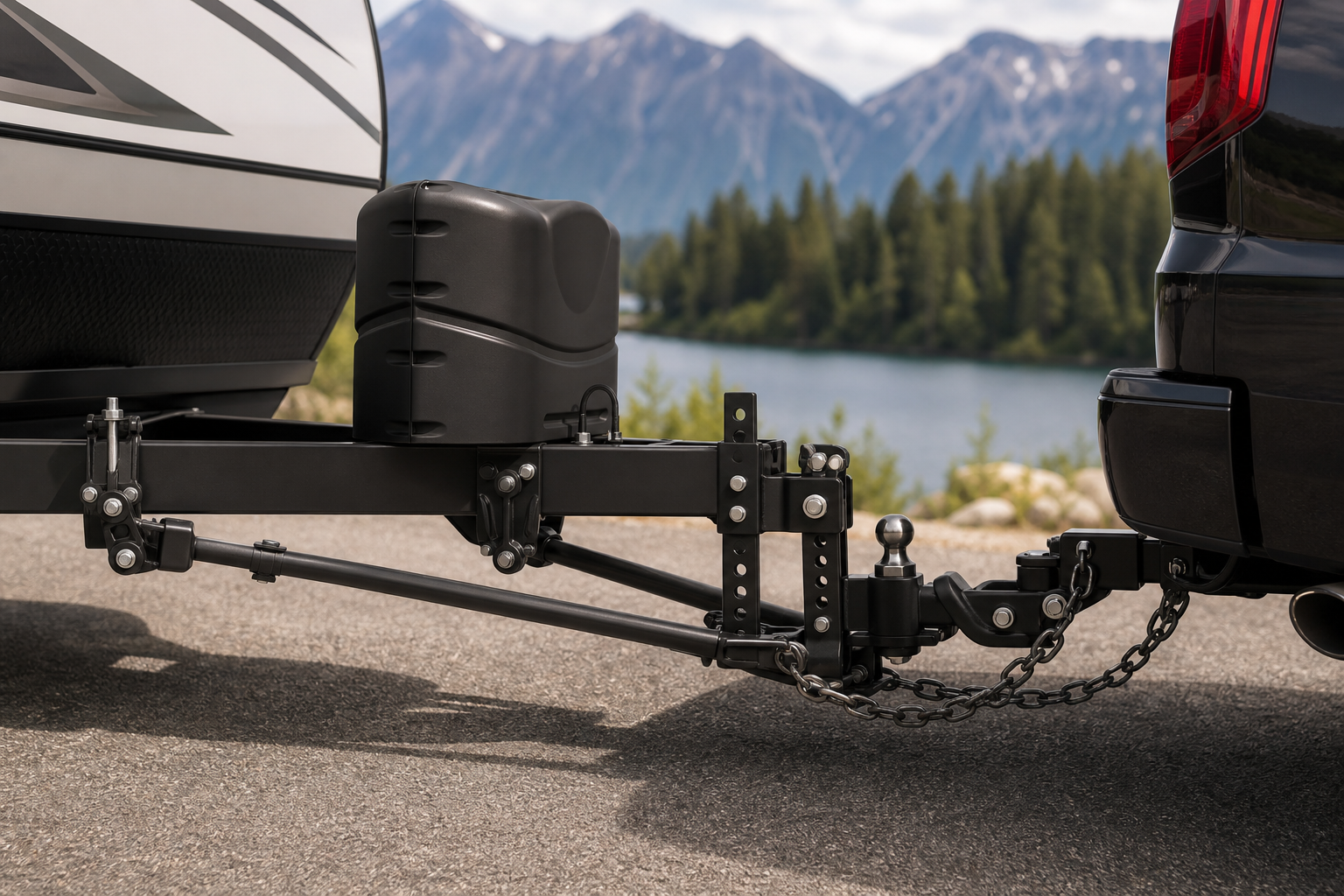
A badly loaded trailer pushes down on the hitch ball hard enough to lighten the front axle of your tow vehicle, making steering feel vague and braking unpredictable at speed. Weight distribution hitches fix that by spreading the load back across all four wheels. In 2026 the market has a handful of genuinely strong designs and many look-alike budget options — here is what independent reviewers and long-term owners actually found after testing them.
The short version
The Equal-i-zer 4-Point is the closest thing to a consensus pick for most towers. It appears at or near the top of every major roundup surveyed — etrailer, Camp Addict, The Camping Nerd, HitchSpecialist — and its 4-point integrated sway control means no separate sway bar to bolt on and no bar-removal routine before backing into a campsite. For buyers who want silence and a hydraulic hookup, the B&W Continuum is the premium upgrade. The Andersen No-Sway is a legitimate lightweight option for rigs under about 8,000 lbs. If maximum sway elimination matters above all else, the ProPride 3P is where the most demanding reviewers land — at a steep price.
What the reviews agree on
Integrated sway control is now the baseline expectation
Across every roundup we read, separate friction sway control bars are treated as outdated. etrailer’s top five picks all use integrated sway control, and Camp Addict does not recommend any system that requires bolting on a dedicated sway bar afterward. The reasons reviewers cite consistently: fewer parts to store, no forgetting to disconnect before reversing, and one fewer adjustment for a new tower to get wrong at setup.
Sizing matters more than brand
Multiple sources make the same point. etrailer, HitchSpecialist, and The Camping Nerd all emphasize: match the hitch’s tongue weight rating to your actual measured tongue weight, not the trailer’s gross weight. A hitch rated far above your tongue weight will under-tension its bars and distribute almost nothing. The Camping Nerd notes weight capacity ranges from 8,000 to over 20,000 lbs GTW across available models, so there is no shortage of options for any rig size.
The Equal-i-zer keeps landing at the top
etrailer lists it third overall but describes its sway control as industry-leading
for windy conditions. The Camping Nerd names it their author’s choice. HitchSpecialist rates it the most reliable option in their test field, pointing to its lifetime warranty and American manufacture. It handles up to 16,000 lbs gross and 1,600 lbs tongue weight, and it works without removing bars to back up. The friction noise on turns is a near-universal complaint across reviews, but most testers dismiss it as minor after a few trips.
The B&W Continuum is the best-reviewed premium unit
etrailer puts it first in their overall ranking. StresslessCamping’s reviewer put 3,400 miles on one and called it the best travel trailer hitch they had ever used. Its hydraulic tensioning system lets you set pressure from one side of the truck, and it adjusts for varying load without swapping components — useful when you sometimes tow a full trailer and sometimes an empty one. It matches the Equal-i-zer on GTW (16,000 lbs) and tongue weight (1,600 lbs), and carries a lifetime warranty. The main complaint from multiple owners: the saddle assembly sits low and has scraped pavement on steep driveway transitions.
Where they disagree
Which hitch is actually best overall
There is no single consensus winner. Camp Addict gives top billing to the Andersen No-Sway for its low weight, grease-free chain mechanism, and simple setup. etrailer puts the B&W Continuum first. The Camping Nerd and HitchSpecialist both land on the Equal-i-zer. RVingKnowHow picks the Blue Ox BXW1000 SWAYPRO, citing its pre-adjusted head that requires no fine-tuning, priced at $969. AutoQuarterly names the Husky Center Line TS best overall at roughly $388. That last pick barely appears in any other major roundup — which illustrates how much editorial angle shapes these lists.
Whether the Andersen works for heavy trailers
Camp Addict rates it their top pick without flagging a weight limit. etrailer lists it fourth and notes it may be limited for trailers above 7,000 lbs. Owner discussions on Jayco RV forums are more specific: tongue weights above 1,000 lbs can stress the chain tensioning mechanism, and several owners reported switching to a conventional spring-bar design after struggling to achieve adequate weight transfer at the top of the Andersen’s range. Below 8,000 lbs loaded trailer weight, reviewers broadly agree it is a quiet, easy choice. Heavier than that, the Equal-i-zer or B&W Continuum draws more support from both testers and owners.
Is the ProPride 3P worth $3,000 or more
The ProPride uses Pivot Point Projection technology, mechanically shifting the trailer’s effective hinge point forward to near the truck’s rear axle, preventing sway through geometry rather than resisting it with friction. Camp Addict and The Camping Nerd both acknowledge it as the state-of-the-art for sway elimination. ProPride’s own comparison content argues that friction-based systems can be overwhelmed by a large crosswind gust, whereas the 3P cannot. Forum discussions on Grand Design RV forums found owners split: those towing large, heavy travel trailers in demanding conditions called the premium justified; owners with lighter rigs said the Equal-i-zer was more than enough. One consistent owner note across threads: the ProPride is heavy and takes more effort to move around a campsite, even though it never requires bar removal before backing up.
Budget picks vary widely by site
Camp Addict favors the Fastway e2 (around $448, 10,000–12,000 lb GTW) as the budget entry, noting it comes from the same manufacturer as the Equal-i-zer. HitchSpecialist picks the EAZ LIFT 48058. AutoQuarterly points to the EAZ Lift Elite Kit. RVingKnowHow lists the EAZ LIFT 48053 at roughly $305. The shared tradeoff across all budget options: 2-point friction sway control rather than 4-point, so they distribute weight adequately but offer less resistance in crosswinds or with a trailer prone to oscillation.
How the top picks compare
| Model | Max GTW | Max TW | Approx. Price | Sway System | Sourced from |
|---|---|---|---|---|---|
| Equal-i-zer 4-Point | 16,000 lbs | 1,600 lbs | ~$1,000 | 4-point integrated | etrailer, Camp Addict, The Camping Nerd, HitchSpecialist |
| B&W Continuum | 16,000 lbs | 1,600 lbs | ~$1,500–2,500 | Hydraulic integrated | etrailer (#1), StresslessCamping |
| Andersen No-Sway | 14,000–16,000 lbs | 1,400 lbs | Mid-premium | Chain tension | Camp Addict (#1), etrailer (#4) |
| ProPride 3P | 20,000 lbs | Varies by kit | ~$3,000+ | Pivot Point Projection | The Camping Nerd, Camp Addict, RV forum owners |
| Blue Ox BXW1000 | 10,000 lbs | 1,000 lbs | ~$969 | Pre-adjusted integrated | RVingKnowHow (#1) |
| Fastway e2 | 10,000–12,000 lbs | 1,000–1,200 lbs | ~$448 | 2-point friction | Camp Addict, etrailer |
| Husky Center Line TS | 12,000 lbs | 1,200 lbs | ~$388 | Chainless design | AutoQuarterly (#1), RVingKnowHow |
| EAZ LIFT 48058 | 10,000 lbs | 1,000 lbs | ~$305 | 2-point friction | HitchSpecialist, RVingKnowHow |
FAQ
Do I actually need a weight distribution hitch?
Most trailer manufacturers and tow vehicle guides require one when tongue weight exceeds 10–15% of the tow vehicle’s curb weight — typically above 500–750 lbs of tongue weight. If your front wheels visibly rise when hitched, or steering feels light at highway speed, you need one. That is a safety issue, not a comfort preference.
What tongue weight rating should I choose?
Match the hitch’s tongue weight rating to your actual measured tongue weight, not the trailer’s gross weight rating. Weigh your setup at a truck stop scale with the trailer loaded exactly as you normally tow. An over-rated hitch under-tensions its bars and distributes very little of the load.
Do I have to remove the bars before backing up?
With older round-bar setups paired with a separate friction sway bar — yes, and many owners forget. The Equal-i-zer, B&W Continuum, Andersen No-Sway, and ProPride 3P all allow backing without removing or adjusting anything. etrailer flags this as a primary differentiator for every unit in its top five.
Is the Equal-i-zer noise actually a problem?
Nearly every reviewer mentions it. The 4-point friction contact produces a grinding or scraping sound on turns. Camp Addict describes the hitch as noisy; etrailer acknowledges audible friction noise on turns. Owners in forum threads generally report they stop noticing it within a few trips. If sound matters — you camp close to others, or you run a short city route daily — the B&W Continuum and Andersen run silently.
How much should I budget, including installation?
$300–500 covers a capable budget kit such as the EAZ LIFT or Fastway e2. $900–1,100 gets a mid-tier unit like the Blue Ox BXW1000 or Equal-i-zer. The B&W Continuum typically runs $1,500–2,500 depending on the kit variant. The ProPride starts around $3,000. Professional installation at a hitch shop typically adds $150–300, and first-time owners should budget for it — initial spring bar tension adjustment makes or breaks how well any of these systems actually works.
Sources
- campaddict.com
- rvingknowhow.com
- stresslesscamping.com
- etrailer.com
- hitchspecialist.com
- thecampingnerd.com
- autoquarterly.com