Air Bag Coil Spring Inserts vs. Air Shocks for Towing: Which Actually Levels Your Rig?
Inserts or shocks — which one actually levels a coil-spring tow rig
For correcting rear squat under tongue weight, coil spring air bag inserts are the more effective tool. Air shocks can take the edge off a mild sag, but they’re a compromise by design, and that compromise shows up exactly when you need them most — under a steady, real load.
How each system works
Coil spring air bag inserts — products like the Air Lift 1000 or Firestone Coil-Rite — are hollow polyurethane or rubber bladders that sit inside the factory coil spring. Inflate them and they increase the spring rate progressively, adding support as the load grows. Your stock spring keeps doing its job; the insert just adds to it.
Air shocks replace the existing shock absorber with a unit that has an air bladder built into or around the shock body. One part, two jobs: damping wheel movement and supporting load. That dual role is the weakness. The bladder is constrained by the physical size of the shock body, and the pressure needed to carry a real load works against the damping the shock is supposed to provide.
Why inserts hold up better under tongue weight
A vehicle’s spring carries the load. The shock controls how fast the spring moves. Keeping those functions separate is why inserts outperform air shocks when there’s sustained weight on the hitch. Air shocks can flatten a mild squat, but under consistent tongue weight they tend to feel vague — the air pressure required to carry the load competes with the shock’s normal damping action.
Inserts don’t touch the shock at all. Your factory dampers keep doing exactly what they were valved to do, and the insert handles load support independently.
Load capacity: putting it in context
The Air Lift 1000 series carries up to 1,000 lbs of leveling capacity per the manufacturer. Firestone’s Coil-Rite sits in a similar range and has confirmed fitment for the GMT360 platform — the shared chassis under the Envoy and TrailBlazer. Either product is well within range for a 350-lb tongue weight.
Air shocks offer less capacity because the bladder has less room to work. They’re fine for balancing uneven cargo on a short run, but asking them to hold a consistent tongue weight load over miles is asking too much of the design.
What inserts won’t do
They don’t raise your towing capacity. The Envoy’s GVWR and max trailer rating stay exactly where the factory set them — inserts change none of that. What they will do is keep the rear from sagging, which keeps headlights aimed correctly, keeps the trailer running level, and gives the whole rig more stable handling overall. Run the manufacturer’s minimum pressure when unladen. Inflate to level when towing. Running at maximum pressure all the time adds unnecessary wear on the bags and the surrounding suspension components.
Installing on the Envoy’s rear coil setup
The GMT360 uses a solid rear axle with open coil springs — a solid candidate for insert kits. That said, installation isn’t always as quick as the box makes it sound. On some kits, the rear coil has to come off the vehicle entirely to get the bag seated inside it correctly. That means disconnecting the lower shock mount, lowering the axle on one side, sliding the spring out, seating the bag, then reversing the process. Budget a real jack-stand afternoon rather than assuming it’s a quick driveway project.
Once the bags are in, most kits require no drilling. Inflation valves typically route to the bumper area or a wheel well. Some owners run a simple Schrader valve at the bumper for manual inflation with a hand pump or compressor; others install an onboard compressor kit for remote adjustment from inside the cab.
Setting the right pressure
Start at the manufacturer’s minimum — often around 5 PSI — when the vehicle is empty. Before a towing run, hook up the loaded trailer and inflate until the rear sits level with the front. Check it visually with the load attached, not in the driveway without it. The right number depends on your specific tongue weight; 35–60 PSI is a common range for moderate loads, but adjust to what actually levels your vehicle rather than targeting a fixed number.
Z71 springs and the weight distribution hitch question
Z71 springs permanently raise the spring rate. They handle tongue weight better than stock, but the trade-off is a noticeably harsher unladen ride. Air bag inserts let you run soft when empty and dial in support only when you need it. That on-demand flexibility is the main reason most occasional towers choose inserts over a spring swap.
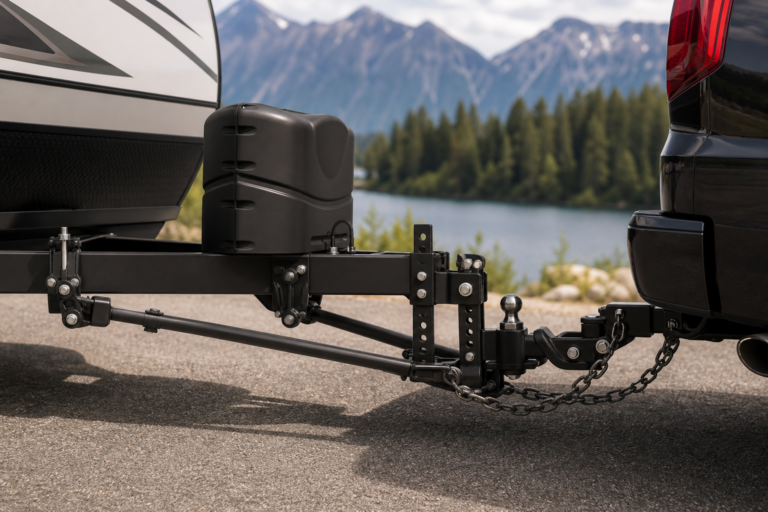
On the weight distribution hitch: for a 350-lb tongue weight, a WDH adds hardware mass without delivering much in return. Most towing references point to 500 lbs and above as the threshold where a WDH starts earning its keep. Below that, leveled suspension and a properly set-up ball mount handle the job without the added complexity and the weight of the hardware itself.
Sources
- airliftcompany.com
- thecampingadvisor.com
- drivingline.com
- etrailer.com
- firestoneairide.com
- dieselarmy.com
- vigorairride.com
- truckspring.com
Related Articles