Best Tire Deflators and Inflators in 2026: What Experts Actually Recommend
Air down before the trail, air up before the highway. Get the tools wrong and you’re kneeling at each wheel for ten minutes or driving home with mismatched pressures. We read every significant expert roundup we could find — Overlandsite, 4WDTalk, Standard Drivetrain, RealTruck, and GearJunkie’s hands-on inflator test — to map where reviewers land and where they disagree.
Short Version
For deflators: the MORRFlate Coyote Vortex ($80) is the current frontrunner for automatic operation; the ARB E-Z Deflator ($84) wins on raw single-tire speed. For inflators: GearJunkie’s timed field tests put the VIAIR 88P ($90) at 3 minutes 10 seconds on a car tire versus the DeWalt 20V MAX’s 7 minutes 42 seconds — but the DeWalt runs on battery, AC outlet, or 12V DC without a running engine. There is genuine disagreement on which deflator earns the top slot, and that split is worth understanding before you buy.
What the Reviews Agree On
Automatic deflators save meaningful time. 4WDTalk puts the savings at 10 to 15 minutes per session versus unscrewing valve cores by hand — a real number on a multi-day trip where you’re airing down before every trail segment.
The Staun Automatic (6–30 PSI, roughly $90) is the baseline every site mentions. Overlandsite calls it the “best premium” screw-on, noting its “easy to calibrate” brass construction and broad owner endorsement. 4WDTalk confirms it as “a proven automatic choice” that has earned its reputation since the early 2000s, pairing a two-year warranty with Australian-made all-brass build quality. The shared knock: the 30 PSI ceiling requires pre-deflation if your street pressure runs above that — common on newer trucks and SUVs.
Boulder Tools’ four-deflator kit ($35) is the agreed-upon budget option across roundups. 4WDTalk says it delivers “80% of the ARB’s functionality at 60% of the price”; Standard Drivetrain scores it 8.8/10 but flags accuracy inconsistencies under repeated use. Both agree the ±3 PSI tolerance is fine for sand and loose dirt and too loose for precise rock-crawling targets.
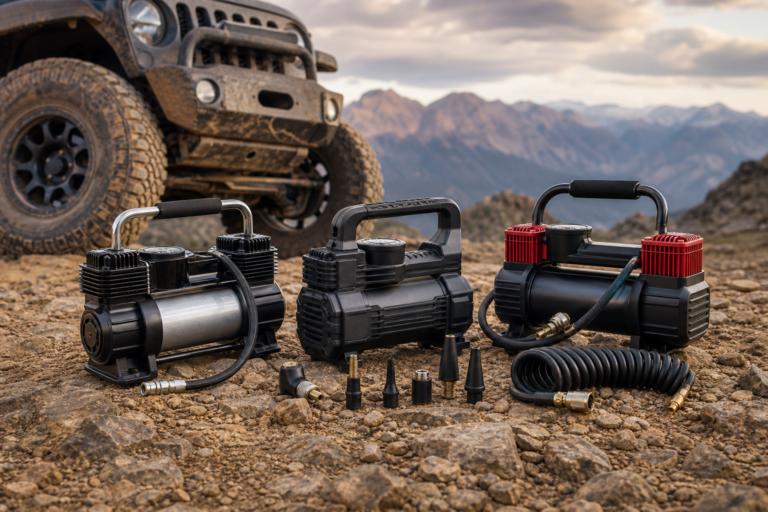
On inflators, GearJunkie’s controlled test is the most specific data in this review set. They deflated a 1997 RAV4’s 215/70 R16 tires to 10 PSI and then inflated an F250’s 285/75 R16 from 20 PSI. The VIAIR 88P finished fastest in both scenarios: 3 minutes 10 seconds on the car, 15 minutes 7 seconds on the truck. The AstroAI ($90) failed the truck test outright. For sustained off-road use on 35-inch tires, WitsEngineer highlights the ARB CKMP12’s 40-minute continuous run time and the VIAIR 300P’s 25-foot hose and thermal overload protection.
The Products, Compared
| Product | Type | Approx. Price | Key Spec | Sourced From |
|---|---|---|---|---|
| MORRFlate Coyote Vortex | Auto screw-on deflator (4-pack) | $80 | 8–65 PSI range; ±0.5 PSI accuracy | 4WDTalk (best overall), Standard Drivetrain |
| MORRFlate Quad+ | Digital 4-tire system | $169–$235 | All 4 tires in 3–4 min; 0.1 PSI resolution | 4WDTalk (best multi-tire) |
| ARB E-Z Deflator | Manual valve-core removal | $84 | ~45 sec/tire; 15–75 PSI digital gauge | Overlandsite (best overall), Standard Drivetrain (9.5/10), 4WDTalk (best manual) |
| Staun Automatic 6–30 PSI | Auto screw-on deflator | ~$90 | ~90 sec/tire; all-brass; 2-year warranty | Overlandsite, 4WDTalk, Standard Drivetrain |
| Boulder Tools Rapid Kit | Valve-core removal + gauge | $35 | ~50 sec/tire; ±3 PSI; 0–100 PSI analog gauge | 4WDTalk (budget pick), Standard Drivetrain (8.8/10), Overlandsite |
| VIAIR 88P | 12V DC inflator | $90 | Car tire 10–45 PSI in 3:10; F250 20–80 PSI in 15:07 | GearJunkie (fastest tested, best heavy-duty) |
| DeWalt 20V MAX | Multi-power inflator | $149 | Car tire in 7:42; truck in 32:36; runs on battery/AC/12V | GearJunkie (best overall) |
| ARB CKMP12 | 12V compressor | Varies | 40-min continuous run; rated for 35-inch tires | WitsEngineer (overlanding pick) |
Where They Disagree
MORRFlate vs ARB: which deflator is actually best?
This is the central split. Overlandsite names the ARB E-Z Deflator best overall, praising its “best in class performance,” accurate gauge, and speed per tire. Standard Drivetrain agrees, scoring it 9.5/10 — the highest in their field. 4WDTalk goes the other way, placing the MORRFlate Coyote Vortex on top because its 8–65 PSI ceiling handles highway pressures without any pre-deflation step — a practical advantage on trucks that leave the factory above 35 PSI. Neither camp is wrong: ARB is faster per tire when you’re attending each wheel; MORRFlate is set-and-forget over a wider pressure range. Your starting street pressure is the deciding variable.
Automatic vs manual: how narrow is the time gap?
4WDTalk clocks all-four-tire deflation with the MORRFlate Coyote Vortex at 3–4 minutes total. The ARB (manual, valve-core removal) runs roughly 45 seconds per tire — about 3 minutes across all four if you move efficiently. The gap is narrower than the marketing suggests. Automatics win on daily convenience when you’re setting and stepping away; manuals win when you need to stop at a specific mid-range pressure or work a single tire in awkward terrain.
Cordless vs 12V inflators: does the speed difference matter on trail?
GearJunkie’s test data is specific enough to answer this. The VIAIR 88P finished the car tire in 3:10; the DeWalt needed 7:42 — more than twice as long. On the truck tire, VIAIR took 15:07; DeWalt took 32:36. The DeWalt’s real advantage is flexibility: it runs on a common 20V battery platform, works at an AC campsite outlet, and needs no running engine. The VIAIR clips to battery terminals and draws the higher current that explains its speed. For 35-inch tires on a regular basis, a 17-minute difference per inflation session is not trivial. GearJunkie’s verdict: DeWalt for versatility, VIAIR 88P for speed and large-tire work.
Is the MORRFlate Quad+ worth the jump to $169?
4WDTalk recommends it for drivers running 35-inch or larger tires on frequent trips, citing 0.1 PSI digital precision and true simultaneous four-tire deflation in 3–4 minutes total. No other roundup in this review set covers the Quad+ with any depth. It is compelling on paper — thin on cross-site validation. Worth considering if you match that specific use profile; not a consensus recommendation.
Rhino USA and JACO RapidFlow: solid picks or single-source noise?
Standard Drivetrain rates the Rhino USA deflator as a runner-up (9.3/10) for its auto-stop technology and ±2 PSI accuracy, and the JACO RapidFlow (9.2/10) for its “1 PSI per second” deflation speed and glow-in-dark dial. Neither product surfaces in the other roundups reviewed here. They may well be solid tools — but calling them consensus picks would be dishonest. Check them if Standard Drivetrain’s methodology resonates with you; otherwise wait for broader cross-site coverage.
Buying Decision
Street pressure at 30 PSI or lower: Staun for the proven classic with a decade-plus reputation, or MORRFlate Coyote Vortex for better accuracy and a wider pressure ceiling. Street pressure above 35 PSI: the Coyote Vortex is the only screw-on automatic that skips the pre-deflation step.
Want the fastest per-tire deflation and don’t mind standing at each wheel? ARB E-Z Deflator at $84. Budget under $40? Boulder Tools at $35 — enter that purchase knowing ±3 PSI is the accuracy floor.
For inflators: if speed on 33-inch or larger tires is the priority, GearJunkie’s numbers point squarely at the VIAIR 88P — with the clear caveats that it needs a running engine and has no auto-shutoff. The DeWalt 20V MAX is the practical pick when you already own 20V batteries and need one unit that works everywhere. For sustained heavy-duty overlanding on 35-inch-plus tires with multi-day run requirements, WitsEngineer and the broader 12V compressor community point to the ARB CKMP12.
FAQ
Do I need both a deflator and an inflator?
Yes, if you’re leaving pavement. A deflator gets pressure down before the trail; an inflator brings it back up before the highway. Running aired-down on tarmac causes sidewall heat buildup and accelerated wear. They solve different problems — most serious overlanders carry both.
How accurate does a tire deflator need to be?
For sand and soft dirt, ±3 PSI is workable. For technical rock crawling, ±1–2 PSI matters — the difference between 12 and 15 PSI changes how a sidewall conforms to a rock face. 4WDTalk reports the MORRFlate Coyote Vortex at ±0.5 PSI, which is class-leading among screw-on automatics.
What off-road PSI should I target?
Common starting points: 15–20 PSI for sand, 20–25 PSI for gravel and dirt roads, 10–15 PSI for technical rock crawling. These shift significantly with tire size, vehicle weight, and sidewall construction — test your specific setup rather than treating any number as universal.
Can a battery-powered inflator handle off-road tires?
On 31–33 inch tires, yes — slowly. GearJunkie clocked the DeWalt 20V MAX at 32 minutes 36 seconds on a 285/75 R16 truck tire; the AstroAI failed the same test. For 35-inch or larger tires with repeated daily use, a 12V compressor drawing power from the vehicle battery is the practical choice.
What is wrong with just pressing the valve pin to air down?
Speed and precision. Pressing the pin by hand takes 5–10 minutes per tire, invites debris into the valve, and gives no way to stop at a target pressure without a separate gauge and constant attention. A valve-core removal deflator — the ARB being the most recommended — does the same job in under 45 seconds.
Sources
Related Articles