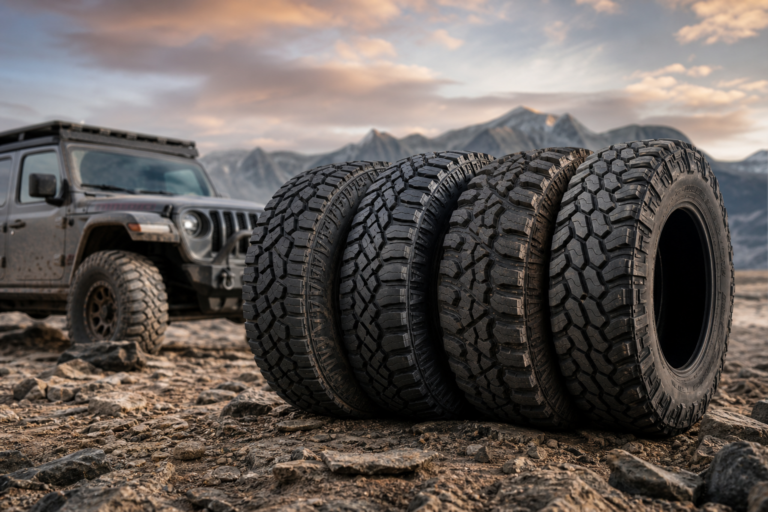
Wider Tires on a 1995 F150 XLT RWD: What Actually Fits Your Stock 15-Inch Aluminum Rims
The 265/75R15 is the most practical wider tire for a 1995 F150 XLT RWD on stock 15-inch aluminum rims. It fits the factory 7.5-inch rim without modification, adds meaningful width and height over the stock 235/75R15, and at stock ride height most owners run it without fender contact.
Stock Specs: What You’re Actually Starting With
The 1995 F150 XLT RWD door sticker calls for a P235/75R15 — a tire that measures roughly 29 inches tall and about 9.3 inches wide. The factory 15-inch aluminum rims on the XLT are typically 7.5 inches wide, on a 5×5.5-inch (5×139.7mm) bolt pattern with a near-zero offset.
Base and XL trims sometimes shipped with narrower 7-inch steel wheels. If you have the aluminum rims from the factory XLT package, 7.5 inches is the working width — and that matters a lot for what tires you can mount.
How Wide Can a 7.5-Inch Rim Handle
Tire manufacturers generally recommend keeping section width within about 25–30mm of the rim width. On a 7.5-inch rim (roughly 190.5mm), that puts the comfortable upper ceiling around 265mm — which is exactly why the 265/75R15 lands so naturally here.
A 275mm tire will mount on a 7.5-inch rim, but the sidewall starts to bulge slightly outward past the tread face. That affects wear and handling over time. Anything much wider than 275mm on a 7.5-inch rim is genuinely asking too much of the bead seat.
Three Sizes That Work for a Street Look at Stock Height
If you want filled-out wheel wells and a meatier road presence without lifting the truck, these are the sizes that realistically work on the stock 7.5-inch rims:
- 265/75R15 — About 30.6 inches tall and 10.4 inches wide. Mounts on the stock rim cleanly, adds roughly 1.7 inches of diameter over the factory 235s, and gives the wheel wells a noticeably fuller look. Most straightforward upgrade.
- 31×10.5R15 — Slightly taller at around 30.9 inches and a touch wider at 10.5 inches. The classic old-school truck size in imperial format. Commonly reported to work on stock-height 1995 F150 2WDs, though it is borderline at full steering lock.
- 275/70R15 — Similar overall diameter to the 265/75 but a slightly lower profile and about 0.4 inches wider. Sits at the edge of what a 7.5-inch rim handles comfortably, but it can be done.
For a street look rather than an off-road look, tread pattern matters as much as size. A highway all-season or mild all-terrain in 265/75R15 — evenly spaced tread blocks, minimal shoulder lugs — keeps the truck reading as a clean road vehicle. The same dimensions in a mud-terrain tread pattern and it reads as an off-road build. The tire, not just the size, sets the visual tone.
The Front End Is Your Real Bottleneck
The rear well on these trucks is generous. The front is where stock-height builds run into trouble.
The 1995 F150 RWD twin I-beam front suspension sits the front end a little lower than the rear — this is stock behavior, not a sag problem, and it means less clearance between the tire and inner fender than it looks like from outside the truck. Most RWD owners running 265/75R15 at stock height report no contact during normal driving. The issue shows up at full steering lock — when you crank the wheel all the way to exit a parking spot or make a U-turn. A wider or taller tire can clip the plastic inner fender liner at that extreme angle.
The fix is usually simple: push the liner back a couple inches, or trim a small section if needed. Nothing structural. Before committing to four tires, do one test — mount them, find an empty lot, and turn lock-to-lock in both directions. Any contact points show up immediately.
Speedometer Drift
Going from a 235/75R15 to a 265/75R15 increases overall tire diameter by about 1.7 inches — roughly a 6% change. Your speedometer reads slow by that same margin. At an indicated 60 mph, actual speed is closer to 63–64 mph.
On a mid-1990s F150, recalibrating the speedometer is not a straightforward job. Most owners cross-check with a GPS app and learn the offset. It is worth knowing before your first highway run.
Measure Your Rims Before You Buy
Confirm your actual rim width before ordering tires. The factory XLT aluminum wheels are typically 7.5 inches wide, but not every truck got the same package. The inner bead-to-bead measurement is what matters for fitment. If your rims turn out to be 7 inches instead of 7.5, your comfortable ceiling drops to around 255–265mm. The 265/75R15 still fits, but is at the top of the range — and the 275/70 becomes a tighter call.
Sources
- tiresize.com
- tirewheelguide.com
- tyresizecalculator.com
- thecarstuff.com
- neotires.com
- rsgoffroad.com
- performanceplustire.com