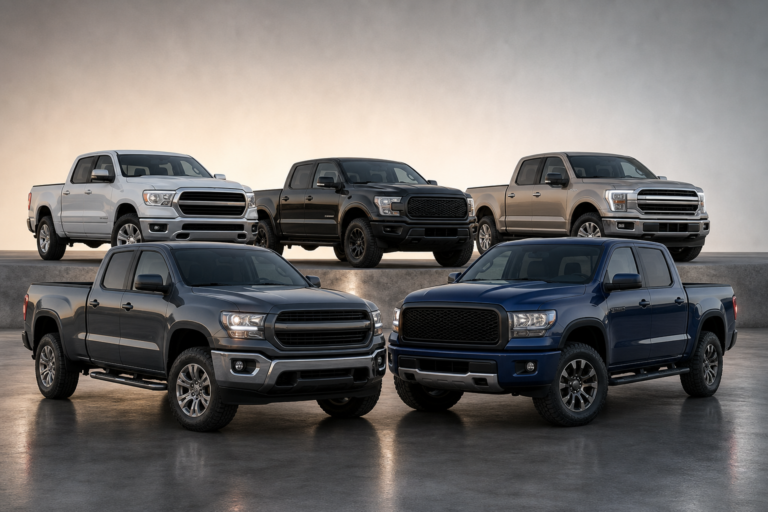
Are Extended Warranties Worth It for New Trucks? The Electronics Factor Changes the Math
Skip the extended warranty. Bank the money instead. That used to be solid advice — trucks were simpler, repairs were more manageable, and the factory coverage was usually enough. That calculus is harder to make in 2026.
Truck prices have moved the baseline
New half-ton pickups start in the high $30,000s at base trim, but most buyers land north of $55,000 once they choose a crew cab and a real-world option level. The 2026 F-150 starts around $40,000, the Ram 1500 around $44,600, and the Silverado 1500 comes in just below the F-150. Those are entry prices. A loaded Silverado ZR2 or a well-optioned F-150 hybrid pushes past $70,000. Higher purchase price means more sophisticated components throughout the truck, and those components cost more to replace when they fail.
Electronics are the real risk factor now
Older trucks mostly failed mechanically. Bearings, gaskets, belts, seals. Modern pickups layer a dense set of electronic systems on top of all that: lane-keep assist, blind-spot monitoring, adaptive cruise control, 360-degree camera arrays, parking sensors, and integrated telematics. These features show up on mid-tier trims now, not just flagship models.
When any of this fails, the costs can surprise you. An infotainment system replacement can run over $1,000. Individual ADAS modules — a camera unit or a radar sensor — can cost $900 to $2,200 each. These aren’t parts you order online and swap in a parking lot.
The calibration problem most buyers don’t see coming
After any ADAS sensor or camera is repaired or replaced, the system has to be recalibrated. Not a quick reset. Actual calibration, using dealer-level target boards, a level shop floor, and sometimes a road test. It is a separate billable service.
Here’s the catch: many extended warranty contracts cover the part and the installation labor but cap calibration reimbursement at one flat hour, or exclude it entirely. You can drive in with a covered repair and leave writing a check for $400 or more. Before signing any contract, that calibration language is the first section worth reading carefully. Some plans have closed this gap in 2026; many still haven’t.
Dealer warranty vs. third-party: how to think about it
OEM-backed service contracts use factory-trained technicians and genuine parts. Claims tend to go more smoothly because the dealer has a direct relationship with the warranty administrator. The downside is price. Dealers mark these up significantly — sometimes double the wholesale cost — and the markup often gets rolled quietly into your loan if you’re financing.
Third-party providers can cost less and frequently let you choose any licensed repair shop, which matters if you have a trusted independent mechanic. The tradeoff is reliability. The quality spread across third-party companies is wide. Some are solid; others use aggressive exclusion clauses to deny claims on technicalities. Stick to providers with at least a decade of history, a clean BBB record, and real customer reviews rather than polished case studies on their own website.
For a brand-new truck, an OEM-backed contract is usually the cleaner option. For a used truck with miles already on it, a well-vetted third-party provider can make more financial sense.
Don’t buy it at the dealership on delivery day
The most common warranty mistake is buying coverage the day you take delivery. That overlap — paying for extended protection on top of the factory bumper-to-bumper coverage you already have — is wasted money. Buy just before the original coverage expires, typically around 3 years or 36,000 miles. Prices don’t shift much whether you buy on day one or a year before expiration. You lose nothing by waiting, and gain several years without paying for duplicate coverage.
When it doesn’t make sense
Extended warranties are insurance products. They work for some buyers and not others. If you trade trucks every three to four years and stay inside the factory warranty window, coverage rarely pencils out. Same if your plan is to sell around 60,000 miles. High-mileage runners should also check contract caps — most extended warranties stop covering well before a well-maintained truck reaches the end of its useful life.
The honest case for buying one is specific: you plan to keep the truck for eight or more years, you’re approaching the end of factory coverage, and an unexpected four-figure repair bill would cause real financial strain. For a $60,000-plus pickup loaded with ADAS electronics, that describes more buyers today than it did five years ago.
Sources
- consumerreports.org
- cars.com
- cars.usnews.com
- kbb.com
- edmunds.com
- consumeraffairs.com
- comparebestwarranties.com
- endurancewarranty.com
Related Articles